WSL Compilation Pipeline
WSL (Workflow Specification Language) provides a declarative syntax for defining workflows.
Pipeline Stages
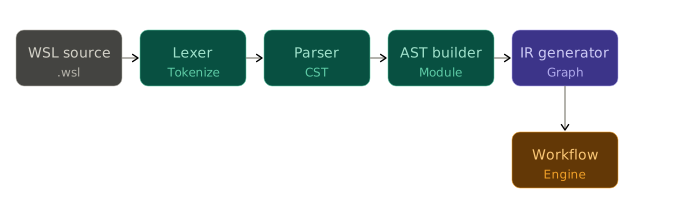
1. Lexer (lexer.go)
Converts WSL source text into tokens.
Token Types:
- Keywords:
module,import,workflow,state,action,on,end - Symbols:
{,},(,),:,,,.,=,|,-> - Literals: strings, numbers, identifiers
2. Parser (parser.go)
Builds a Concrete Syntax Tree (CST) from tokens.
3. AST Builder (build_ast.go)
Transforms CST into an Abstract Syntax Tree with semantic meaning.
AST Structure:
type Module struct {
    Name      string
    Imports   []Import
    Extends   []string
    Context   []Field
    Constants []Constant
    Workflows []Workflow
}

type Workflow struct {
    Name   string
    Start  string
    States map[string]*State
}

type State struct {
    Name        string
    Params      []string
    Action      *Action
    Transitions []Transition
    End         *End
}
4. IR Generator (ir.go)
Creates an execution graph from the AST.
type Graph struct {
    WorkflowName string
    Nodes        map[string]*Node
    Start        string
    Constants    map[string]string
}

type Node struct {
    Name         string
    Action       *Action
    ParamNames   []string
    Edges        []Edge
    Terminal     bool
    TerminalKind string
    Attr         map[string]string
}
WSL Example
module example

import services/common

const {
    event: "greet",
    description: "A simple hello world workflow"
}

workflow hello_world {
    start: Hello

    state Hello {
        action converse/speak.Say(message: "Hello World")
        on success -> Response
    }

    state Response {
        action services/common/response.ResponseValue(statusCode: 200)
        end ok
    }
}
Template Parser
The template parser (engine/workflow/parser.go) processes string templates with dynamic value resolution.
Template Syntax
| Syntax | Description | Example |
|---|---|---|
<<key>> | Simple property lookup | <<username>> |
<<key.field>> | Nested field access | <<user.profile.name>> |
<<key??default>> | Default value fallback | <<name??Guest>> |
<<func(args)>> | Function call | <<format(date, "YYYY-MM-DD")>> |
&arg | Pass by reference | <<process(&data)>> |
ParseTemplate Function
func ParseTemplate(template string, p *WorkerSessionContext) (string, error)
Process:
- Match
<<...>>tokens using regex - Check for function calls (pattern:
name(args)) - Resolve function arguments recursively
- Call function via reflection or lookup in DI
- For non-function tokens, resolve from context
- Handle pipe modifiers (
|) - Recursively process nested templates
Token Resolution
func resolveToken(token string, tokenRe *regexp.Regexp, p *WorkerSessionContext) (string, error)
Supports:
- Simple keys:
<<key>> - Nested paths:
<<obj.field.subfield>> - Default values:
<<key??fallback>> - Slice indexing:
<<array.0>> - Map access:
<<map.key>>
Function Invocation
func callFunction(functionName string, args []interface{}, p *WorkerSessionContext) (string, error)
Resolution Order:
- Look up in session context properties
- Look up in DI container with
helpers:prefix - Invoke via reflection
WSL Integration
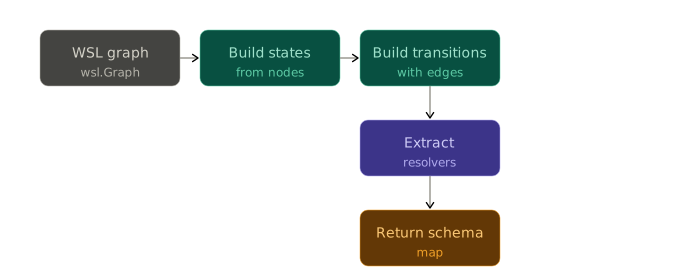
The WSL integration (engine/workflow/wsl_integration.go) converts parsed WSL graphs to engine-compatible Flow schemas.
wslGraphToSchema
func wslGraphToSchema(g *wsl.Graph) map[string]interface{}
Converts a WSL Graph to the JSON structure expected by domain.Flow.FromMap.
Conversion Process:
WSL Value Parsing (literals.go)
Parses WSL inline values:
func parseWSLValue(raw string) (interface{}, bool)
Supported Types:
| Type | Example | Result |
|---|---|---|
| Object | {key: "value"} | map[string]interface{} |
| Integer | 42 | int |
| Float | 3.14 | float64 |
| Boolean | true, false | bool |
| String | "text", 'text' | string |
| Placeholder | $Var | "<<Var>>" |
Edge Condition Mapping
| WSL Condition | Engine Mapping |
|---|---|
on success | true field |
on error | false field |
else | else field |
| Expression | else (fallback) |