Worker
Worker Deep Dive (worker.go)
The worker.go file implements the core Worker interface and the workflowWorker struct, which is responsible for processing workflow states and managing transitions.
Worker Structure
type workflowWorker struct {
    WorkflowContext       WorkerContext                           // Shared context across workflow
    Transitions           map[string]interfaces.ServiceTransitions // Registered transitions
    TransitionsResolved   map[string]*ServiceTransitionMapping    // Resolved transition mappings
    TransitionsNamespaces []string                                // Namespace paths for resolution
    Response              *WorkerResponse                          // Final workflow response
    Debug                 bool                                     // Debug mode flag
    Options               map[string]interface{}                   // Additional options
}
Key Worker Methods
Start(w EngineInterface) bool
Initializes the worker by resolving all transition handlers from the DI container.
func (baseWorker *workflowWorker) Start(w EngineInterface) bool {
    baseWorker.InitResolvers(w.GetResolvers())
    return true
}
InitResolvers(resolvers []string)
Resolves transition handlers from the dependency injection container:
- Iterates through resolver paths (e.g.,
services/common/response) - Looks up each resolver in the DI container using the transition prefix
- Stores resolved
ServiceTransitionMappingfor later use - Tracks namespaces for relative path resolution
PrepareContext(w EngineInterface, flow *domain.Flow) bool
Sets up the workflow context with essential references:
func (baseWorker *workflowWorker) PrepareContext(w EngineInterface, flow *domain.Flow) bool {
    baseWorker.WorkflowContext.SetValue("workflow.Flow", flow)
    baseWorker.WorkflowContext.SetValue("workflow.EngineInterface", w)
    baseWorker.WorkflowContext.SetValue("workflow.Worker", baseWorker)
    return true
}
ProcessState(w EngineInterface, flow *domain.Flow) (bool, string)
The main state processing method. This is where the magic happens:
- Parameter Binding: Binds call arguments to state parameters
- Conditional Execution: Evaluates
if/elseconditions on transitions - Nested Workflows: Handles
workflow:prefixed states for sub-workflow execution - Transition Resolution: Finds the appropriate transition handler
- Method Invocation: Calls the transition method via reflection
- Result Processing: Handles success/failure and determines next state
┌─────────────────────────────────────────────────────────────────────┐
│                        ProcessState Flow                            │
├─────────────────────────────────────────────────────────────────────┤
│  1. Parse state name (extract method path)                          │
│  2. Create WorkerSessionContext                                     │
│  3. Bind parameters from transition options                         │
│  4. Evaluate if/else conditions                                     │
│  5. Check for nested workflow (workflow: prefix)                    │
│  6. Resolve transition handler                                      │
│  7. Call transition method via CallTransitionByName                 │
│  8. Process FlowStepResult                                          │
│  9. Handle true/false branch routing                                │
│  10. Return (success, nextStateName)                                │
└─────────────────────────────────────────────────────────────────────┘
Step 1 — Initialisation
The function begins by parsing the current state name (which may carry an optional #comment suffix), extracting the command prefix (e.g. workflow:), promoting a parent flow stored in the shared context, and constructing the WorkerSessionContext that every transition will receive.
func (baseWorker *workflowWorker) ProcessState(w EngineInterface, flow *domain.Flow) (bool, string) {
    // Strip inline comment: "MyState#some-comment" → command[0] = "MyState"
    comments := strings.Split(flow.CurrentState.State, "#")
    command := strings.SplitN(comments[0], ":", 2) // e.g. ["workflow", "my_wf"] or ["MyState"]

    // Promote a parent flow injected by a sub-workflow caller
    context := baseWorker.WorkflowContext.Context()
    if parentFlow, ok := (*context)["Parent"]; ok {
        flow.Parent = parentFlow.(*domain.Flow)
        delete(*context, "Parent")
    }

    // Build the per-state execution context passed to every transition
    workerSessionContext := WorkerSessionContext{
        WorkflowContext: baseWorker.WorkflowContext,
        Worker:          baseWorker,
        Flow:            flow,
        Engine:          w,
    }
    // ...
}
Step 2 — Parameter Binding
States can declare named parameters (e.g. state Process(UserData)) whose values are supplied by the calling transition. ProcessState resolves those values and injects them into the session context before the transition method is invoked.
// Bind call arguments to target state parameters (if provided)
if flow.CurrentTransition != nil && flow.CurrentState != nil && flow.CurrentTransition.Options != nil {

    // 1. Resolve parameter names
    //    Priority: transition option "_call.paramNames" > state option "_params"
    var paramNames []string
    if pn, ok := flow.CurrentTransition.Options["_call.paramNames"]; ok {
        if arr, ok := pn.([]interface{}); ok {
            for _, v := range arr {
                if s, ok := v.(string); ok {
                    paramNames = append(paramNames, s)
                }
            }
        }
    }
    if len(paramNames) == 0 && flow.CurrentState.Options != nil {
        if pn, ok := flow.CurrentState.Options["_params"]; ok {
            if arr, ok := pn.([]interface{}); ok {
                for _, v := range arr {
                    if s, ok := v.(string); ok {
                        paramNames = append(paramNames, s)
                    }
                }
            }
        }
    }

    if len(paramNames) > 0 {
        // 2. Resolve positional argument list from "_call.args.map"
        //    The map is keyed by the predecessor state name so different callers
        //    can pass different arguments to the same target state.
        var argsList []string
        if amap, ok := flow.CurrentTransition.Options["_call.args.map"]; ok {
            if m, ok := amap.(map[string]interface{}); ok {
                // Determine the predecessor ("from") state
                from := "_"
                if flow.LastTrace != nil && flow.LastTrace.GetFrom() != "" {
                    from = flow.LastTrace.GetFrom()
                }

                // Lookup order (most-specific first):
                //   1. Exact state name          e.g. "ValidateOrder#1"
                //   2. Name without hash suffix   e.g. "ValidateOrder"
                //   3. Wildcard key               "_"
                candidates := []string{from}
                if idx := strings.Index(from, "#"); idx > 0 {
                    candidates = append(candidates, from[:idx])
                }
                if from != "_" {
                    candidates = append(candidates, "_")
                }
                for _, key := range candidates {
                    if raw, ok := m[key]; ok {
                        if arr, ok := raw.([]interface{}); ok {
                            for _, v := range arr {
                                if s, ok := v.(string); ok {
                                    argsList = append(argsList, s)
                                }
                            }
                        }
                        break // use the first matching key
                    }
                }
            }
        }

        // 3. Evaluate and bind each argument positionally into the session context
        //    If no args were found the state parameters remain unset (treated as optional).
        if len(argsList) > 0 {
            for i, pname := range paramNames {
                if i >= len(argsList) {
                    break
                }
                raw := strings.TrimSpace(argsList[i])

                // Type inference for literal values:
                //   "quoted"  → string (quotes stripped)
                //   42 / 3.14 → int / float64
                //   true/false → bool
                //   anything else → resolved from the flow context via ParseProperty
                var val interface{} = raw
                if len(raw) >= 2 &&
                    ((raw[0] == '"' && raw[len(raw)-1] == '"') ||
                        (raw[0] == '\'' && raw[len(raw)-1] == '\'')) {
                    val = strings.Trim(raw, "\"'")
                } else if iv, err := strconv.ParseInt(raw, 10, 64); err == nil {
                    val = int(iv)
                } else if fv, err := strconv.ParseFloat(raw, 64); err == nil {
                    val = fv
                } else if strings.EqualFold(raw, "true") || strings.EqualFold(raw, "false") {
                    val = strings.EqualFold(raw, "true")
                } else {
                    // Resolve as a context property reference (e.g. $User.ID)
                    if _, resolved, err := workerSessionContext.ParseProperty(raw); err == nil {
                        val = resolved
                    }
                }

                // Inject resolved value so the transition can read it via ctx.Context("pname")
                workerSessionContext.SetContext(pname, val)
            }
        }
    }
}
Key design decisions in parameter binding:
| Concern | Solution |
|---|---|
| Multiple callers pass different args to one state | _call.args.map keyed by predecessor state name |
State name may carry a #suffix (e.g. #1 for deduplicated state copies) | Hash suffix stripped before map lookup: "State#1" → "State" |
| Caller not in map | Falls back to wildcard key "_" |
| No args at all | State parameters left unset; treated as optional |
| Literal vs. dynamic values | Type inference: quoted → string, numeric → int/float64, true/false → bool, otherwise ParseProperty |
Error Handling
The worker provides comprehensive error handling:
func (baseWorker *workflowWorker) HandleError(err interface{}, statusCode int) (success bool)
func (baseWorker *workflowWorker) SetError(error *issues.Issue, statusCode ...int) bool
func (baseWorker *workflowWorker) SetErrors(errors *issues.Issues, statusCode ...int) bool
func (baseWorker *workflowWorker) ProcessStateError(w EngineInterface, flow *domain.Flow, errorMessage string)
Transition Invocation (call_function.go)
The call_function.go file handles dynamic method invocation on transition handlers using Go's reflection capabilities.
CallTransitionByName
The main function for invoking transition methods:
func CallTransitionByName(
    path string,                                                    // e.g., "services/common/response/ResponseValue"
    workerSessionContext *WorkerSessionContext,                     // Current session context
    transition *ServiceTransitionMapping,                           // Resolved transition mapping
    metaCache map[string]map[string]map[string]interfaces.FunctionMetadata // Metadata cache
) ([]reflect.Value, error)
Invocation Process
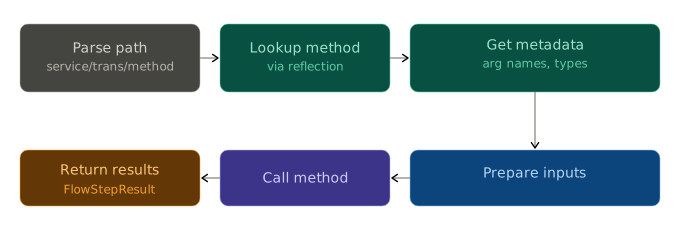
PrepareInput
Prepares method arguments by looking up values from the session context:
func PrepareInput(
    workerSessionContext *WorkerSessionContext,
    expectedType reflect.Type,
    argName string
) (reflect.Value, error)
Process:
- Looks up argument value using
ExprLookup(handles<<property>>syntax) - Falls back to direct context map lookup
- Casts the value to the expected type
CastInput
Handles type conversion between context values and expected method parameter types:
func castInput(val any, expectedType reflect.Type) (reflect.Value, error)
Conversion Strategies:
- Direct Assignment: If types are directly assignable
- Map to Struct: JSON marshal/unmarshal for map → struct pointer conversion
- Type Conversion: For convertible types (e.g., int → float64)
- JSON Serialization: For complex types to string conversion
Worker Session Context (worker_session_context.go)
The WorkerSessionContext provides a rich API for accessing and manipulating workflow data during state execution.
Structure
type WorkerSessionContext struct {
    Engine          EngineInterface  // Reference to the workflow engine
    Flow            *domain.Flow     // Current flow state
    Worker          Worker           // Parent worker reference
    WorkflowContext WorkerContext    // Shared workflow context
    ServerContext   baseContext.Context // Server-level context
}
Property Resolution
The session context implements a sophisticated property resolution system:
Property Syntax
| Syntax | Description | Example |
|---|---|---|
key | Direct property lookup | username |
key.nested | Nested property access | user.profile.name |
<<key>> | Template-style reference | <<userId>> |
key|modifier | Property with type modifier | count|int |
key??default | Default value fallback | name??"Unknown" |
Available Modifiers
| Modifier | Description |
|---|---|
int | Convert to integer |
string | Convert to string |
bool | Convert to boolean |
pint | Parse and convert to int |
pstring | Parse and convert to string |
option | Lookup from flow options |
strings | Convert to string slice |
parse | Parse template expressions |
property | Treat value as property key |
Key Methods
Context Management
func (p *WorkerSessionContext) StartStep() *WorkerSessionContext
func (p *WorkerSessionContext) UpdateContext() *map[string]interface{}
func (p *WorkerSessionContext) Context(key string) interface{}
func (p *WorkerSessionContext) SetContext(key string, value interface{}) *WorkerSessionContext
Value Access
func (p *WorkerSessionContext) Value(key string) interface{}
func (p *WorkerSessionContext) SetValue(key string, value interface{}) *WorkerSessionContext
func (p *WorkerSessionContext) Option(key string) interface{}
func (p *WorkerSessionContext) Property(key string) interface{}
Property Resolution
func (p *WorkerSessionContext) GetProperty(prop string) (key string, value interface{}, err error)
func (p *WorkerSessionContext) ParseProperty(prop string) (key string, value interface{}, err error)
func (p *WorkerSessionContext) RecursiveParseProperty(prop interface{}) (key string, value interface{}, err error)
Type Helpers
func (p *WorkerSessionContext) String(key string, byDefault ...string) string
func (p *WorkerSessionContext) Int(key string, byDefault ...int) (value int, ok bool)
func (p *WorkerSessionContext) Bool(key string) bool
Lookup Priority
The context uses a hierarchical lookup order:
┌─────────────────────────────────────────────────────────────────────┐
│                      Property Lookup Order                          │
├─────────────────────────────────────────────────────────────────────┤
│  1. values (workflow-scoped values set during execution)            │
│  2. transition options (current transition's options)               │
│  3. flow options (workflow-level options)                           │
│  4. parent.transition options (parent workflow's transition)        │
│  5. parent options (parent workflow's options)                      │
│  6. context root (direct context keys)                              │
│  7. constants (module-level constants)                              │
└─────────────────────────────────────────────────────────────────────┘
Expression Lookup (ExprLookup)
The ExprLookup method provides advanced expression evaluation:
func (p *WorkerSessionContext) ExprLookup(argName string) (value interface{}, err error)
Process:
- Handle
<<key>>template syntax - Look up property value
- Recursively parse if value contains templates
- Return resolved value
Return Value Handling
States can return values that subsequent states can access:
// Set return value for current transition
func (p *WorkerSessionContext) Return(value interface{}) *WorkerSessionContext

// Get return value from previous state
func (p *WorkerSessionContext) LastReturn() interface{}